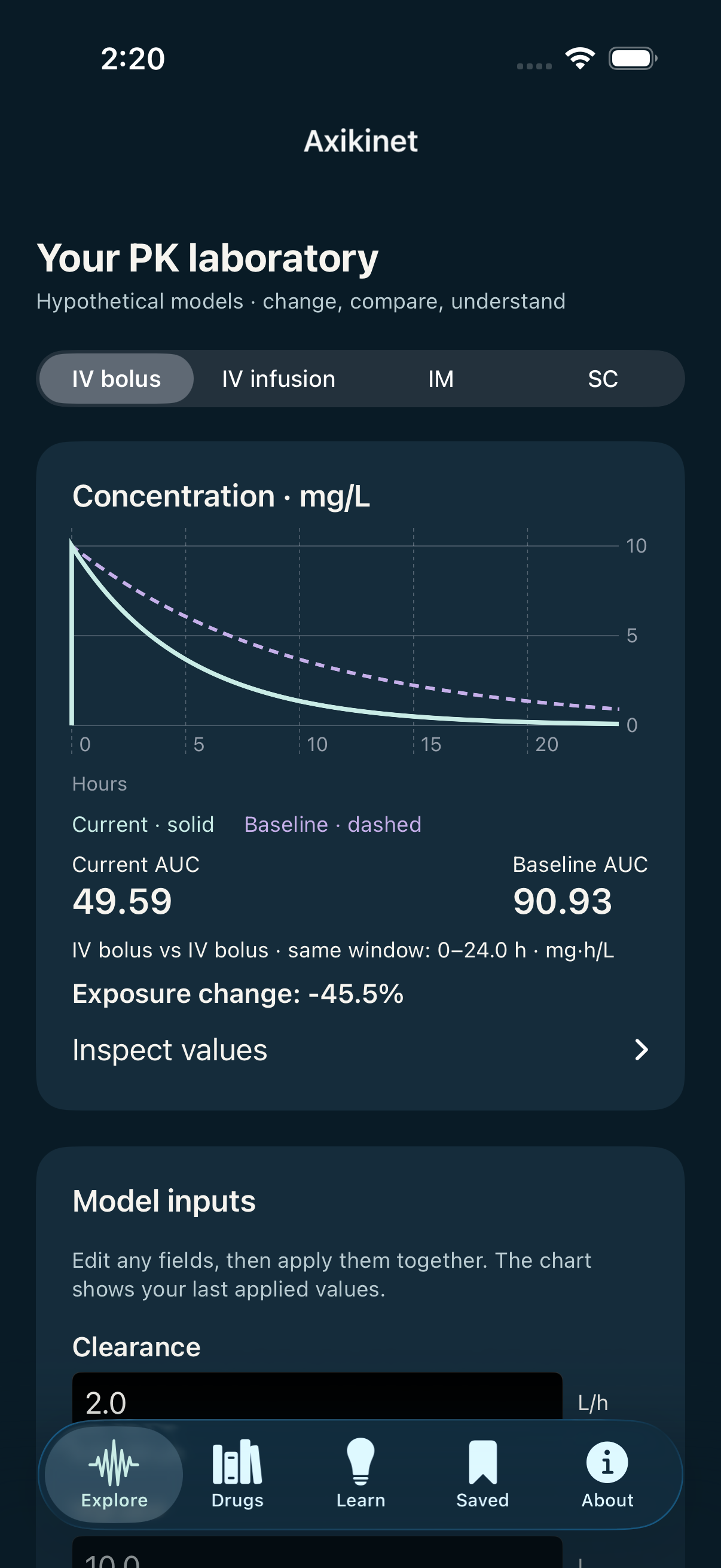
Run an experiment
Change bounded hypothetical inputs, pin a baseline, compare exposure measures, and save the experiment for later.

AxiKinet by Axiwoven
Development build 0.7.2AxiKinet turns PK concepts into short experiments. Make a prediction, change a model input, inspect the concentration-time curve, and explain what happened.
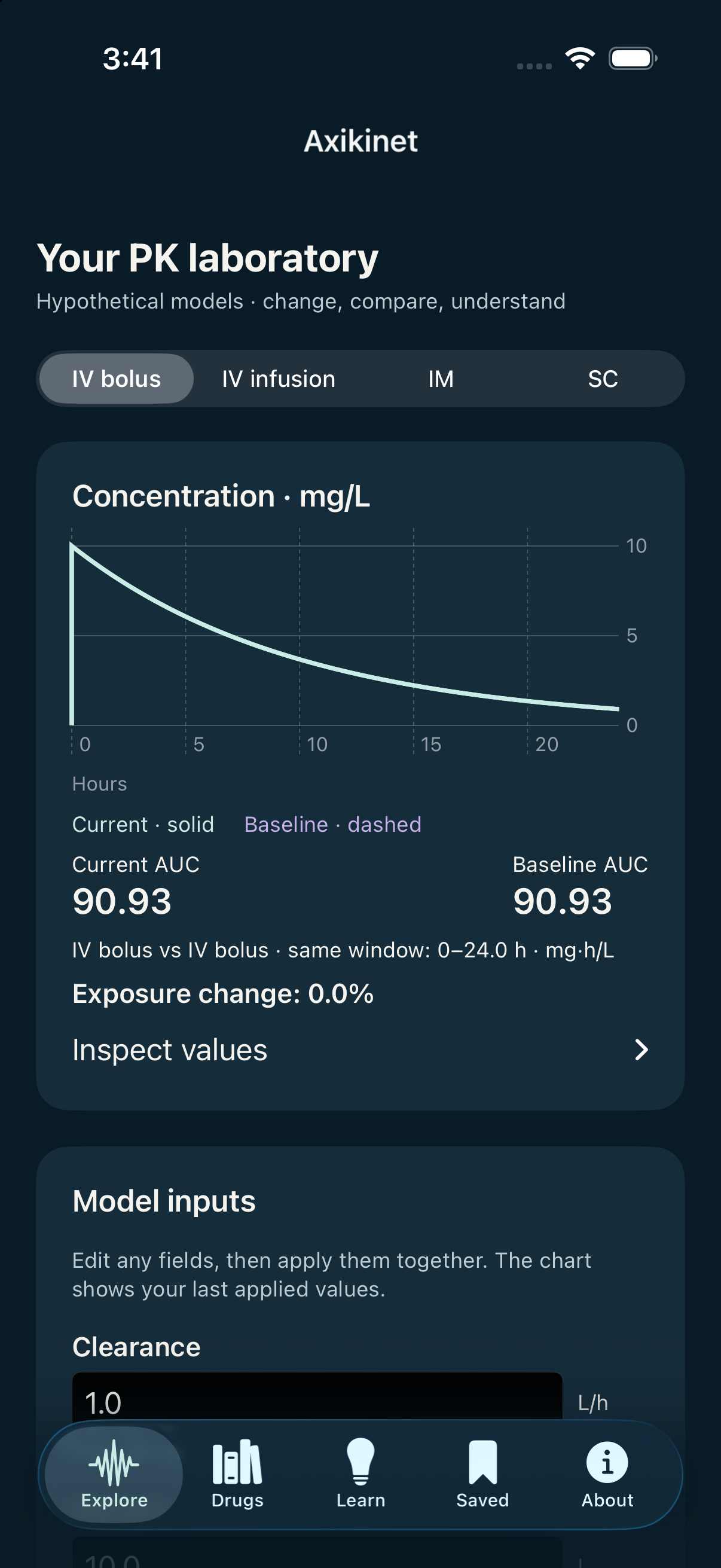
An earlier development screen from the model laboratory. The current build adds clearer guidance and twelve lessons across four learning paths.
Inside the build
Every result remains tied to its input values, model type, time window, and source context.
Change bounded hypothetical inputs, pin a baseline, compare exposure measures, and save the experiment for later.
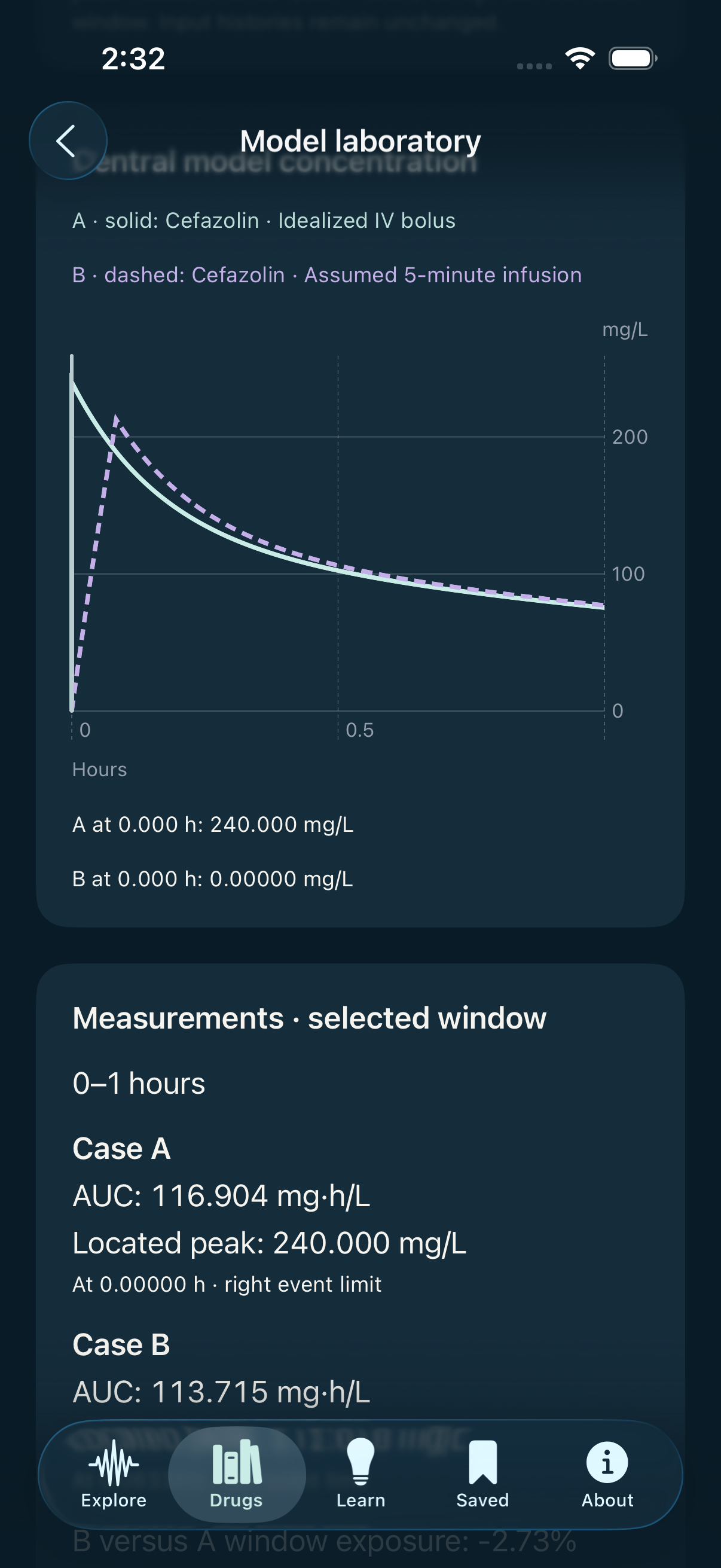
Plot selected cases on the same axes, choose the observation window, and inspect differences in peaks and exposure.
Predict the result, run the model, explain the curve, apply the idea to a second example, and finish with a short check.
Learning design
A first-run guide explains Explore, Drugs, Learn, and Saved, along with the app's scientific limits.
Each of the nine chart types includes a text interpretation and a matching accessibility description.
Each path ends with three questions. Results are stored locally, and missed concepts link back to the relevant lesson.
What changed in 0.7.2
Scientific scope
The build includes illustrations based on retatrutide, semaglutide, tirzepatide, and historical cefazolin cases. Introductory PK/PD lessons use synthetic, unitless effects rather than clinical endpoints.
AxiKinet does not predict an individual's response, evaluate efficacy or safety, set clinical thresholds, or recommend a dose.
Review the references and source statusVerification status
AxiKinet is development-stage educational software. It is not medical advice, clinical decision support, or a validated tool for individual prediction.
Development updates
Get occasional AxiKinet and AxiPrep updates, including requests for early testers. The list is managed manually.